You are building boring products


There is a strange point in every product journey where things are going exactly right and that's when you can start having a problem.
I ran into this recently while working on something I thought was really cool(at least it appeared that way to me :P). If you work in building products, you keep having these moments, only to regret them later. In my case, when that cool thing was published, there was a problem: it wasn't particularly usable. So I started working on the UI. I didn't add anything groundbreaking, I just made the existing experience easier to understand and use.
It worked.
Engagement increased by almost an hour per user.
I was like, cool, I cracked it.
A week later, the graph had stopped moving. There was no further increase.
Around the same time, I noticed something else. One of the users had been extremely active for some time. They were regularly using the product, trying different things and exploring what it could do. Then, suddenly, they stopped.
First reaction - What did I miss in the flow? Did something get hard to use? Did the user find a better alternative? Was something broken? Is he on leave?
But initially, it never appeared what if nothing had gone wrong? What if the user had simply reached a point where he was no longer interested?
We don't stop liking things. We stop discovering things.
Think about starting a new job.
In the beginning, almost everything is interesting because almost everything is new. You're figuring out how people work, how decisions get made, where the problems are, which systems do what and which meetings somehow became your problem.
After a while, you understand most of it. You know the people, the systems and the problems. The job may not have become worse. There is simply less left to discover.
Friendships can work the same way. You can still like someone and enjoy spending time with them, but you might not feel the same need to meet every other day once. You've spent enough time to know each other's stories, habits and opinions.
Products go through something similar.
When we first encounter a product, we're in discovery mode. We don't know what it can do, how it works or how useful it might be. Then we start exploring it, finding useful workflows and figuring out how it fits into what we need.
Eventually, the product becomes familiar. We know where things are. We know what it can do. We know how to get the value we want from it.
And then at some point, we reach a thing called saturation.
The journey from discovery to saturation
The journey has four stages: Discovery → Exploration → Familiarity → Saturation.
- Discovery is when curiosity is highest because almost everything is new.
- During Exploration, the user starts trying things, finding value and figuring out different ways to use the product.
- In Familiarity, the product becomes part of the user's routine. They know how it works, and engagement starts to stabilize.
- Then comes Saturation.
The user knows the product. They know what it can do. Their usage becomes predictable, and eventually there isn't much left to explore.
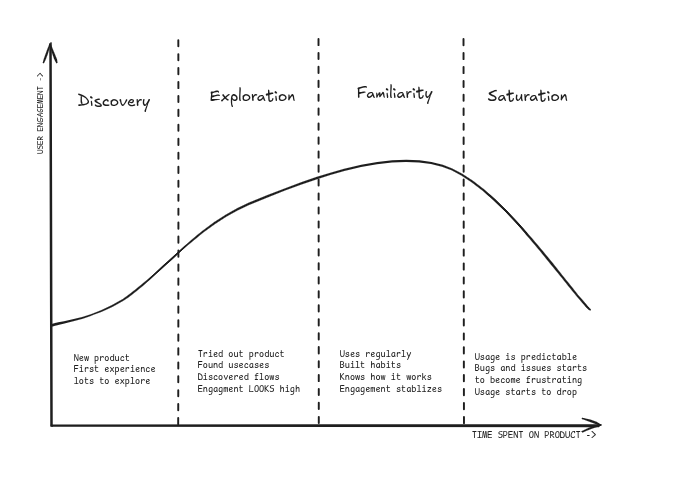
And many times saturation can look a lot like product failure. Most product teams end up panicking here and blast to make something work, but what you really need is to go one step back.
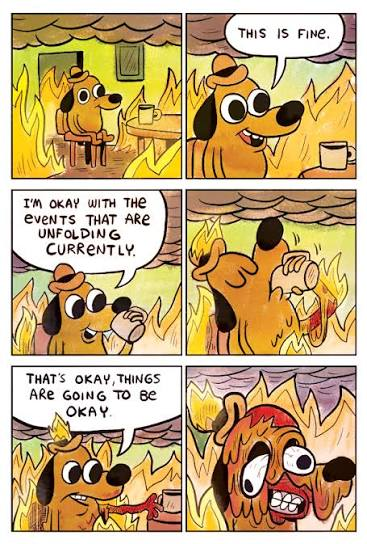
Saturation isn't dissatisfaction
A dissatisfied user: "This product isn't giving me what I need."
A saturated user: "I already know what this product can give me."
The usage for both looks the same. Declining, but they need completely different responses.
If the user is dissatisfied, there is something missing or something not working. You need to understand the problem and fix it.
If the user is saturated, the problem is different. They may already understand the product perfectly well. Making the same experience slightly easier or adding another small improvement may not give them a reason to come back.
They need something new to explore.
What happens after saturation?
This is where products that have something new waiting for users have an advantage.
- Take Netflix. You don't need Netflix to keep changing its interface to make the product interesting. You already know how to browse and play something. What changes is what's available to watch.
- The same is true for Reddit. The interface can remain familiar because the reason you open it is that there might be something new waiting for you.
- The same applies to Instagram and YouTube. The container becomes familiar, while the things inside it keep changing.
And by "content", I don't just mean articles, videos or social posts. It could be a new conversation, recommendation, alert, dataset, feature, person, use case or anything else that gives the user something they haven't encountered before.
That gives the product a way to restart the cycle. The user reaches saturation, encounters something new and moves back into discovery and exploration.
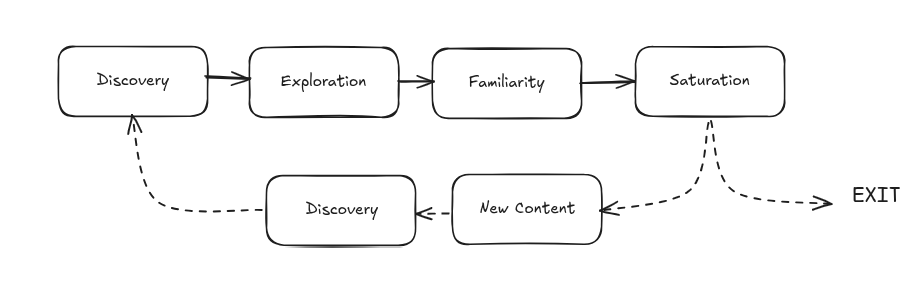
They don't have to relearn the product. They just have a new reason to use it.
The product is a container
This also explains why constantly changing the product itself isn't pulling users.
If the interface keeps changing just to make the product feel new, users have to relearn where everything is. The thing that was supposed to create engagement ends up creating friction.
A good product should actually become familiar.
You shouldn't have to figure out where the search button moved every time you open an app. You shouldn't need a tutorial every week to understand how the basic experience works.
The product is a container. The container needs to become predictable.
What changes is what the user can discover inside it.
A perfectly designed container with nothing new inside it will eventually become predictable. Predictability is useful when you're trying to complete a task. It's less useful when there is no longer anything interesting to explore.
That's why a product can be well designed, easy to use and genuinely liked, and still in loss.
AI has made this particularly obvious
AI products make this easier to see because the demo and the actual product experience can be so different.
A good AI demo creates a huge amount of discovery. You show someone ten things they didn't know the product could do, and suddenly they can imagine twenty more.
Then they start using it.
After a while, they figure out the workflows that are actually useful to them. They learn what works, what doesn't, and what they actually need. The product becomes part of their routine.
Nothing necessarily went wrong. The demo created discovery. The actual product now has to keep creating reasons to explore.
So when engagement falls...
Our first instinct is usually to ask, "What's missing?" That's a useful question, but it isn't the only one.
Was the user able to get value from the product? Did something become difficult to use? Did they understand what was possible?
And then: what is left for this user to discover?
- If something is missing, build it.
- If something is difficult, simplify it.
- If the user doesn't know what is possible, make it easier to discover.
But if the user has simply explored everything that currently matters to them, another usability improvement may not be enough.
They may just need something new. You can prevent saturation and that's the irony.
I still like Notion. I just don't use it anymore. I loved Call of Duty. I don't play it anymore either. Nothing dramatic happened. I didn't suddenly decide those products were bad. I was just done with them. You would have such a list of products as well. Not every user leaving is bad, but tracing back decides that.
It's about how to keep users comfortable with the product while feeding their curiosity dopamine.


